توجه !
این رویداد خاتمه یافته است و اطلاعات موجود در این سایت صرفا جنبه آرشیو دارد
لطفا منتظر بمانید ...
0% Complete
English
رفتن به صفحه اصلی
ارائه مجازی مقاله
لیست نشست ها
ارايه پوستر- محور مراقبت پرستاری
مشخصات مقاله
کد مقاله
1404
منابع مقاله
عنوان
The Role of Nurses in the Process of Organ Donation, Harvest and Transplantation in Children: A Literature Review
نویسندگان
Latif Panahi - Somaye Pouy
چکیده
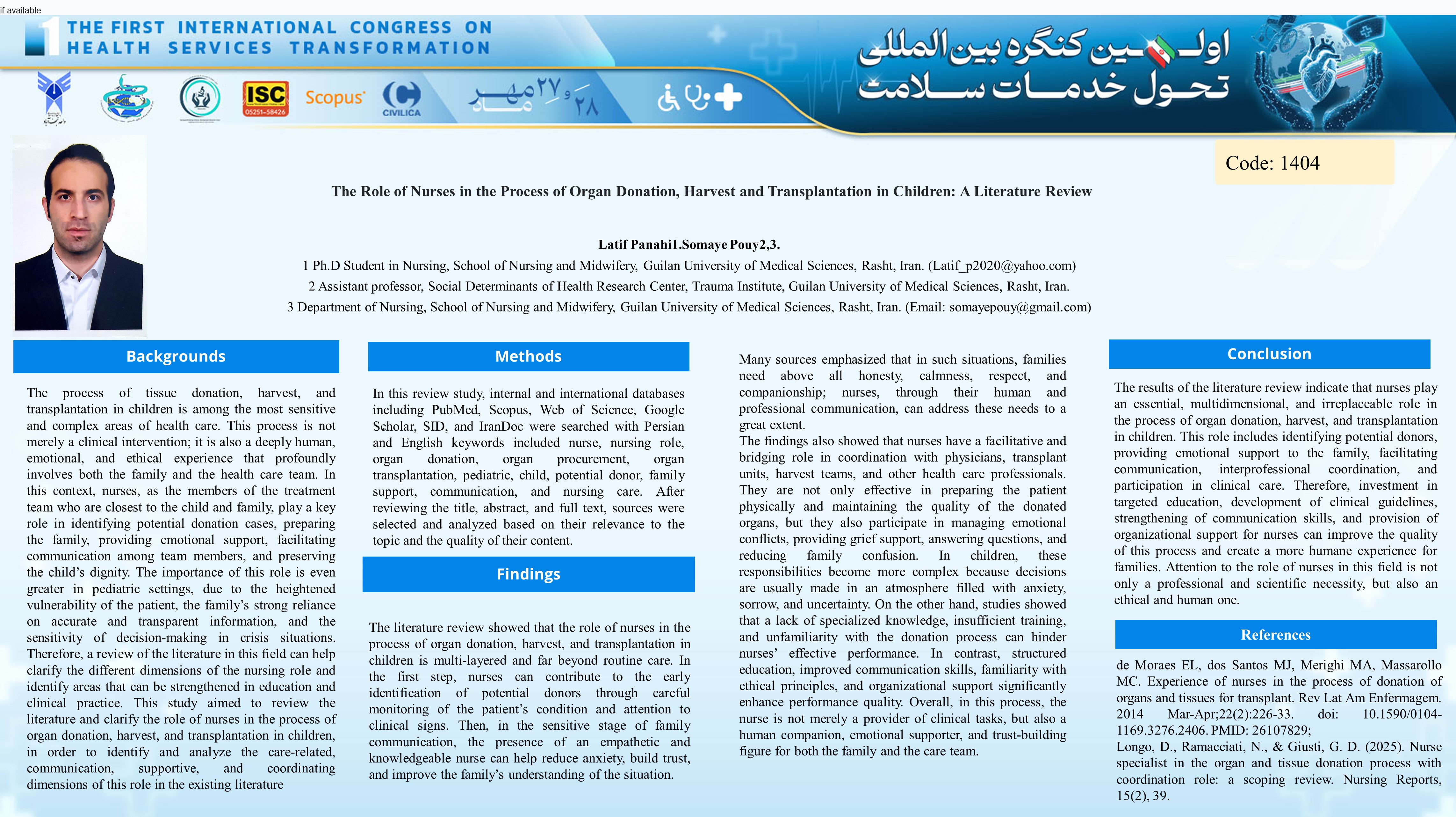
Introduction: The process of tissue donation, harvest, and transplantation in children is among the most sensitive and complex areas of health care. This process is not merely a clinical intervention; it is also a deeply human, emotional, and ethical experience that profoundly involves both the family and the health care team. In this context, nurses, as the members of the treatment team who are closest to the child and family, play a key role in identifying potential donation cases, preparing the family, providing emotional support, facilitating communication among team members, and preserving the child’s dignity. The importance of this role is even greater in pediatric settings, due to the heightened vulnerability of the patient, the family’s strong reliance on accurate and transparent information, and the sensitivity of decision-making in crisis situations. Therefore, a review of the literature in this field can help clarify the different dimensions of the nursing role and identify areas that can be strengthened in education and clinical practice. Aim: This study aimed to review the literature and clarify the role of nurses in the process of organ donation, harvest, and transplantation in children, in order to identify and analyze the care-related, communication, supportive, and coordinating dimensions of this role in the existing literature. Methods: In this review study, internal and international databases including PubMed, Scopus, Web of Science, Google Scholar, SID, and IranDoc were searched with Persian and English keywords included nurse, nursing role, organ donation, organ procurement, organ transplantation, pediatric, child, potential donor, family support, communication, and nursing care. After reviewing the title, abstract, and full text, sources were selected and analyzed based on their relevance to the topic and the quality of their content. Results: The literature review showed that the role of nurses in the process of organ donation, harvest, and transplantation in children is multi-layered and far beyond routine care. In the first step, nurses can contribute to the early identification of potential donors through careful monitoring of the patient’s condition and attention to clinical signs. Then, in the sensitive stage of family communication, the presence of an empathetic and knowledgeable nurse can help reduce anxiety, build trust, and improve the family’s understanding of the situation. Many sources emphasized that in such situations, families need above all honesty, calmness, respect, and companionship; nurses, through their human and professional communication, can address these needs to a great extent. The findings also showed that nurses have a facilitative and bridging role in coordination with physicians, transplant units, harvest teams, and other health care professionals. They are not only effective in preparing the patient physically and maintaining the quality of the donated organs, but they also participate in managing emotional conflicts, providing grief support, answering questions, and reducing family confusion. In children, these responsibilities become more complex because decisions are usually made in an atmosphere filled with anxiety, sorrow, and uncertainty. On the other hand, studies showed that a lack of specialized knowledge, insufficient training, and unfamiliarity with the donation process can hinder nurses’ effective performance. In contrast, structured education, improved communication skills, familiarity with ethical principles, and organizational support significantly enhance performance quality. Overall, in this process, the nurse is not merely a provider of clinical tasks, but also a human companion, emotional supporter, and trust-building figure for both the family and the care team. Conclusion: The results of the literature review indicate that nurses play an essential, multidimensional, and irreplaceable role in the process of organ donation, harvest, and transplantation in children. This role includes identifying potential donors, providing emotional support to the family, facilitating communication, interprofessional coordination, and participation in clinical care. Therefore, investment in targeted education, development of clinical guidelines, strengthening of communication skills, and provision of organizational support for nurses can improve the quality of this process and create a more humane experience for families. Attention to the role of nurses in this field is not only a professional and scientific necessity, but also an ethical and human one. Keywords: Nurses, Organ Donation, Transplantation, Children.
فایل ها
فایل پوستر مقاله
محتوای ارائه مجازی مقاله
نظرات
ثمین همایش، سامانه مدیریت همایش ها و جشنواره ها - نگارش 44.12.4

 فایل پوستر مقاله