توجه !
این رویداد خاتمه یافته است و اطلاعات موجود در این سایت صرفا جنبه آرشیو دارد
لطفا منتظر بمانید ...
0% Complete
English
رفتن به صفحه اصلی
ارائه مجازی مقاله
لیست نشست ها
ارايه پوستر- محور مراقبت پرستاری
مشخصات مقاله
کد مقاله
1416
منابع مقاله
عنوان
Optimal Placement of Skin Temperature Sensors in Neonates Admitted to the Neonatal Intensive Care Unit (NICU): A Review of Clinical Evidence
نویسندگان
Somaye Pouy - Latif Panahi - Mona Hoseinzadeh Seyghalani - Zahra Tavakolnia
چکیده
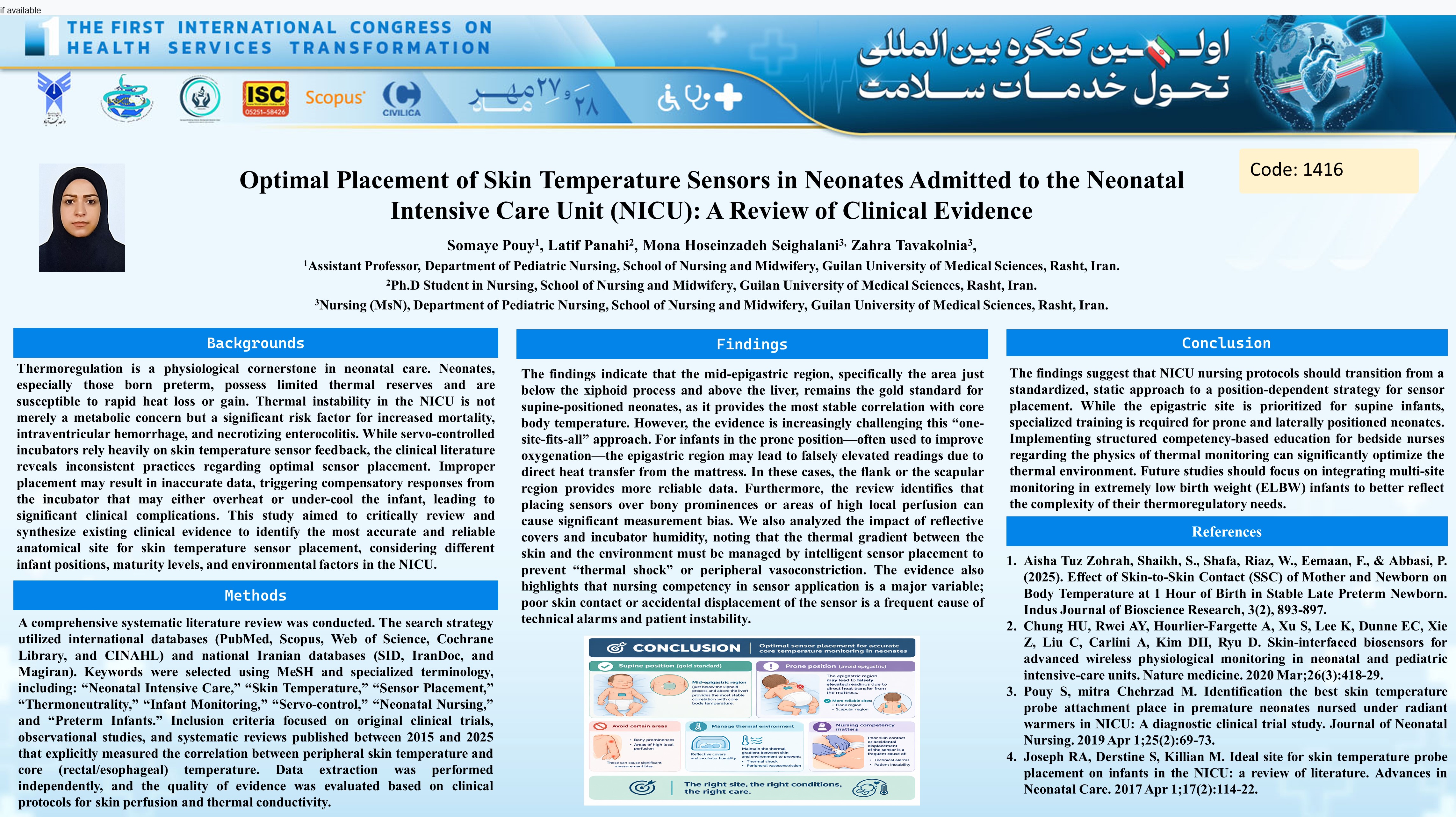
Introduction: Thermoregulation is a physiological cornerstone in neonatal care. Neonates, especially those born preterm, possess limited thermal reserves and are susceptible to rapid heat loss or gain. Thermal instability in the NICU is not merely a metabolic concern but a significant risk factor for increased mortality, intraventricular hemorrhage, and necrotizing enterocolitis. While servo-controlled incubators rely heavily on skin temperature sensor feedback, the clinical literature reveals inconsistent practices regarding optimal sensor placement. Improper placement may result in inaccurate data, triggering compensatory responses from the incubator that may either overheat or under-cool the infant, leading to significant clinical complications. Aim: This study aimed to critically review and synthesize existing clinical evidence to identify the most accurate and reliable anatomical site for skin temperature sensor placement, considering different infant positions, maturity levels, and environmental factors in the NICU. Methods: A comprehensive systematic literature review was conducted. The search strategy utilized international databases (PubMed, Scopus, Web of Science, Cochrane Library, and CINAHL) and national Iranian databases (SID, IranDoc, and Magiran). Keywords were selected using MeSH and specialized terminology, including: “Neonatal Intensive Care,” “Skin Temperature,” “Sensor Placement,” “Thermoneutrality,” “Infant Monitoring,” “Servo-control,” “Neonatal Nursing,” and “Preterm Infants.” Inclusion criteria focused on original clinical trials, observational studies, and systematic reviews published between 2015 and 2025 that explicitly measured the correlation between peripheral skin temperature and core (rectal/esophageal) temperature. Data extraction was performed independently, and the quality of evidence was evaluated based on clinical protocols for skin perfusion and thermal conductivity. Results: The findings indicate that the mid-epigastric region, specifically the area just below the xiphoid process and above the liver, remains the gold standard for supine-positioned neonates, as it provides the most stable correlation with core body temperature. However, the evidence is increasingly challenging this “one-site-fits-all” approach. For infants in the prone position-often used to improve oxygenation-the epigastric region may lead to falsely elevated readings due to direct heat transfer from the mattress. In these cases, the flank or the scapular region provides more reliable data. Furthermore, the review identifies that placing sensors over bony prominences or areas of high local perfusion can cause significant measurement bias. We also analyzed the impact of reflective covers and incubator humidity, noting that the thermal gradient between the skin and the environment must be managed by intelligent sensor placement to prevent “thermal shock” or peripheral vasoconstriction. The evidence also highlights that nursing competency in sensor application is a major variable; poor skin contact or accidental displacement of the sensor is a frequent cause of technical alarms and patient instability. Conclusion: The findings suggest that NICU nursing protocols should transition from a standardized, static approach to a position-dependent strategy for sensor placement. While the epigastric site is prioritized for supine infants, specialized training is required for prone and laterally positioned neonates. Implementing structured competency-based education for bedside nurses regarding the physics of thermal monitoring can significantly optimize the thermal environment. Future studies should focus on integrating multi-site monitoring in extremely low birth weight (ELBW) infants to better reflect the complexity of their thermoregulatory needs.
فایل ها
فایل پوستر مقاله
محتوای ارائه مجازی مقاله
نظرات
ثمین همایش، سامانه مدیریت همایش ها و جشنواره ها - نگارش 44.12.4

 فایل پوستر مقاله