توجه !
این رویداد خاتمه یافته است و اطلاعات موجود در این سایت صرفا جنبه آرشیو دارد
لطفا منتظر بمانید ...
0% Complete
English
رفتن به صفحه اصلی
ارائه مجازی مقاله
لیست نشست ها
ارائه پوستر- محور فناوری های نوین و هوش مصنوعی
مشخصات مقاله
کد مقاله
1418
منابع مقاله
عنوان
The Role of Telemedicine and Digital Health in the Continuity of Palliative Care: Challenges and Opportunities
نویسندگان
Somaye Pouy - Marziyeh Ahmadi - Zahra Tavakolnia - Mona Hoseinzadeh Seyghalani
چکیده
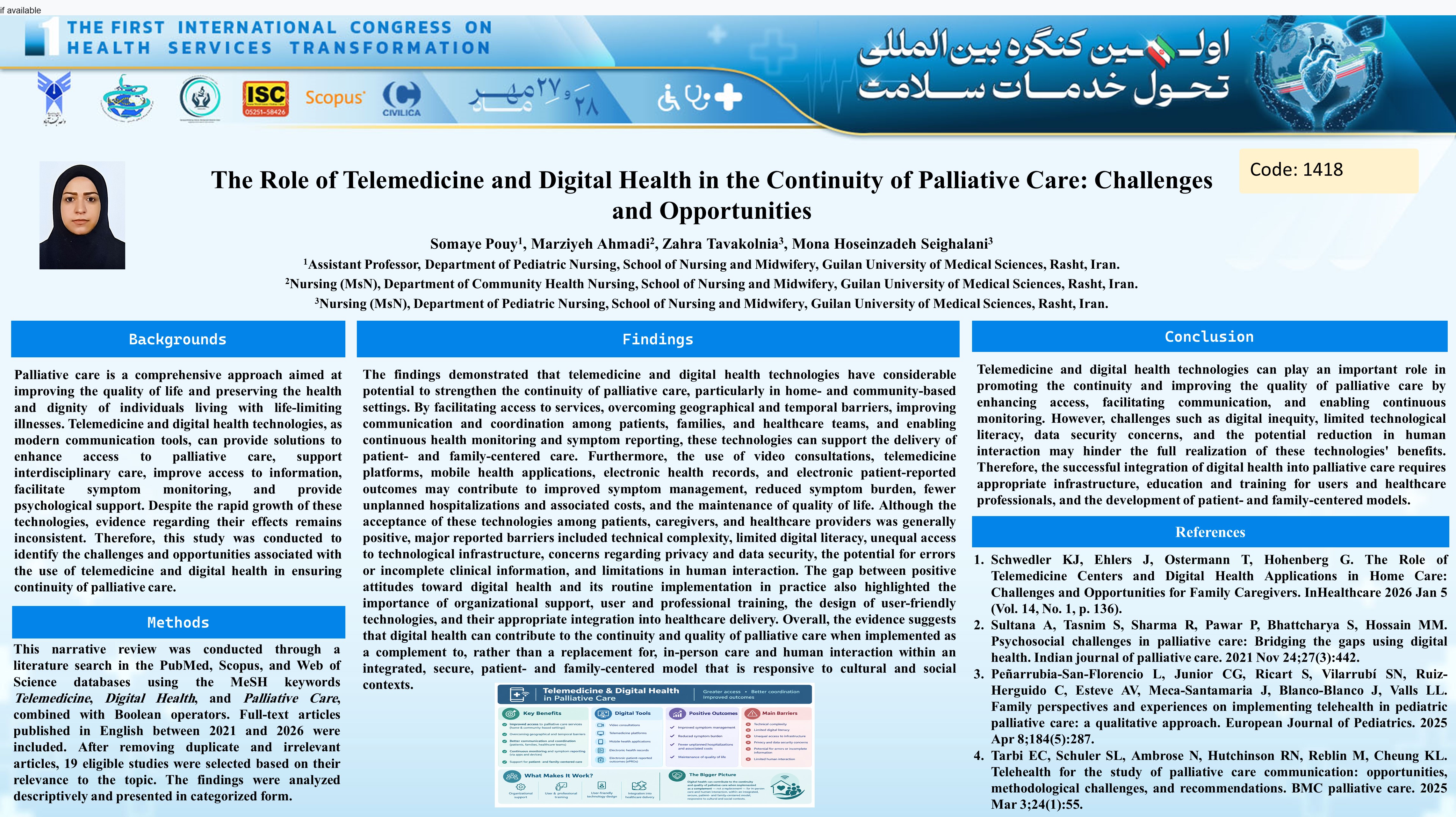
Introduction and Aim: Palliative care is a comprehensive approach aimed at improving the quality of life and preserving the health and dignity of individuals living with life-limiting illnesses. Telemedicine and digital health technologies, as modern communication tools, can provide solutions to enhance access to palliative care, support interdisciplinary care, improve access to information, facilitate symptom monitoring, and provide psychological support. Despite the rapid growth of these technologies, evidence regarding their effects remains inconsistent. Therefore, this study was conducted to identify the challenges and opportunities associated with the use of telemedicine and digital health in ensuring continuity of palliative care. Materials and Methods: This narrative review was conducted through a literature search in the PubMed, Scopus, and Web of Science databases using the MeSH keywords Telemedicine, Digital Health, and Palliative Care, combined with Boolean operators. Full-text articles published in English between 2021 and 2026 were included. After removing duplicate and irrelevant articles, 19 eligible studies were selected based on their relevance to the topic. The findings were analyzed descriptively and presented in categorized form. Results: The findings demonstrated that telemedicine and digital health technologies have considerable potential to strengthen the continuity of palliative care, particularly in home- and community-based settings. By facilitating access to services, overcoming geographical and temporal barriers, improving communication and coordination among patients, families, and healthcare teams, and enabling continuous health monitoring and symptom reporting, these technologies can support the delivery of patient- and family-centered care. Furthermore, the use of video consultations, telemedicine platforms, mobile health applications, electronic health records, and electronic patient-reported outcomes may contribute to improved symptom management, reduced symptom burden, fewer unplanned hospitalizations and associated costs, and the maintenance of quality of life. Although the acceptance of these technologies among patients, caregivers, and healthcare providers was generally positive, major reported barriers included technical complexity, limited digital literacy, unequal access to technological infrastructure, concerns regarding privacy and data security, the potential for errors or incomplete clinical information, and limitations in human interaction. The gap between positive attitudes toward digital health and its routine implementation in practice also highlighted the importance of organizational support, user and professional training, the design of user-friendly technologies, and their appropriate integration into healthcare delivery. Overall, the evidence suggests that digital health can contribute to the continuity and quality of palliative care when implemented as a complement to, rather than a replacement for, in-person care and human interaction within an integrated, secure, patient- and family-centered model that is responsive to cultural and social contexts. Conclusion: Telemedicine and digital health technologies can play an important role in promoting the continuity and improving the quality of palliative care by enhancing access, facilitating communication, and enabling continuous monitoring. However, challenges such as digital inequity, limited technological literacy, data security concerns, and the potential reduction in human interaction may hinder the full realization of these technologies' benefits. Therefore, the successful integration of digital health into palliative care requires appropriate infrastructure, education and training for users and healthcare professionals, and the development of patient- and family-centered models.
فایل ها
فایل پوستر مقاله
محتوای ارائه مجازی مقاله
نظرات
ثمین همایش، سامانه مدیریت همایش ها و جشنواره ها - نگارش 44.12.4

 فایل پوستر مقاله