توجه !
این رویداد خاتمه یافته است و اطلاعات موجود در این سایت صرفا جنبه آرشیو دارد
لطفا منتظر بمانید ...
0% Complete
English
رفتن به صفحه اصلی
ارائه مجازی مقاله
لیست نشست ها
ارايه پوستر- درمان
مشخصات مقاله
کد مقاله
1569
منابع مقاله
عنوان
Preparation and Evaluation of Quercetin-Loaded Astragalus Polysaccharide Nanoparticles for Improving Antibacterial Effects
نویسندگان
Parnian Soleimani - Ladan Dayani - Vajihe Akbari
چکیده
Background: Quercetin has several biological activities, including antibacterial effects, but its poor aqueous solubility can limit formulation and delivery. Astragalus polysaccharide has been investigated as a natural carrier and has also been reported to improve the solubility and stability of flavonoids. This study aimed to prepare quercetin-loaded Astragalus polysaccharide nanoparticles and evaluate their physicochemical characteristics and antibacterial activity. Method: Polysaccharide was extracted from the aerial parts of Astragalus gossypinus. Six formulations containing different amounts of Astragalus polysaccharide and Pluronic were prepared. Particle size, zeta potential, drug loading, encapsulation efficiency, and saturation solubility were measured. The formulation selected in the thesis was further evaluated by an eight-hour release study and by FTIR, DSC, XRD, and SEM. Antibacterial activity was assessed against Staphylococcus aureus and Escherichia coli using broth-dilution and inhibition-zone methods. Finding: Particle size ranged from 178.10±3.43 to 476.66±6.02 nm and all formulations had negative zeta potentials. Encapsulation efficiency ranged from 96.52% to 99.81%. P1A25 was selected in the original study on the basis of the combined physicochemical findings. The selected formulation released 49.65±0.44% of quercetin during the first two hours, followed by slower release. Structural analyses were consistent with physical incorporation of quercetin into the polysaccharide matrix. The MIC of free quercetin was 800 µg/mL for S. aureus and 400 µg/mL for E. coli. At 800 µg/mL, inhibition zones were 20.0±1.0 mm and 23.5±0.7 mm, respectively. Conclusion: The prepared system achieved high quercetin entrapment and showed gradual drug release and concentration-dependent antibacterial activity. The findings support further evaluation of Astragalus polysaccharide as a carrier for quercetin.
فایل ها
فایل پوستر مقاله
محتوای ارائه مجازی مقاله
نظرات
ثمین همایش، سامانه مدیریت همایش ها و جشنواره ها - نگارش 44.12.4

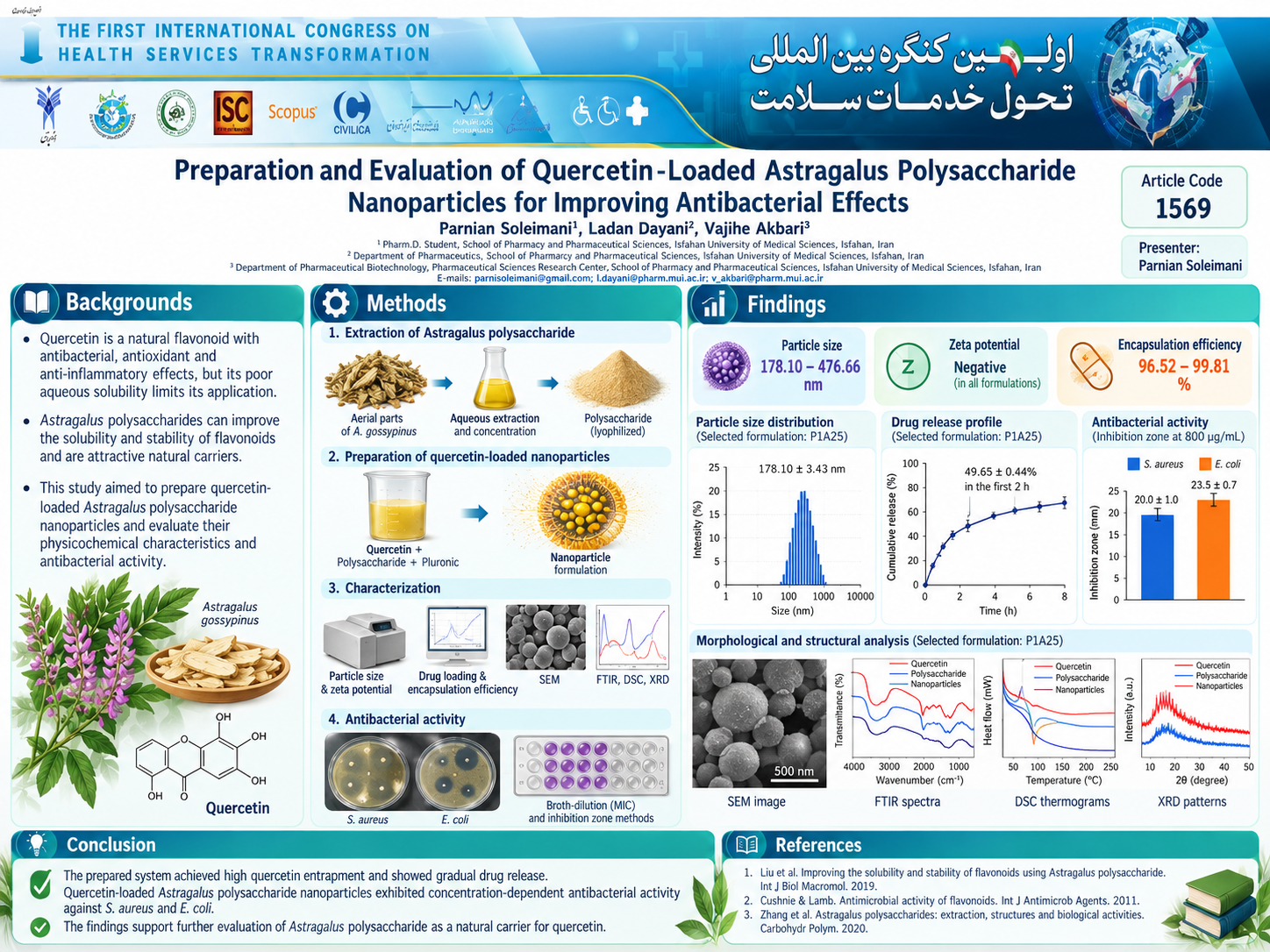 فایل پوستر مقاله